
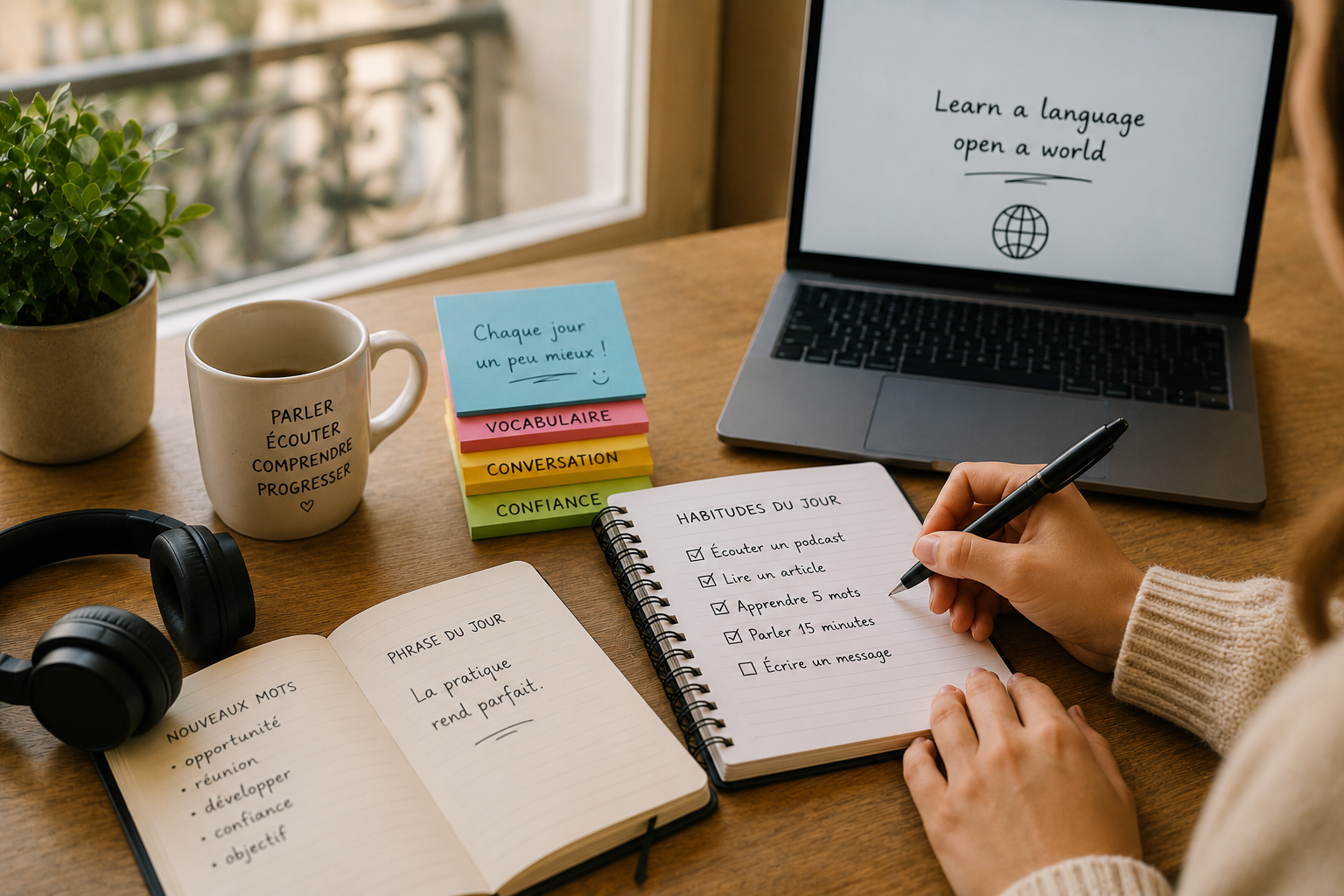
Learning a language doesn’t necessarily mean spending hours every week studying from a textbook. In reality, it is often the small habits repeated every day that lead to the greatest progress.
Here are a few simple habits you can easily incorporate into your daily routine, even if you have a busy schedule.
1. Spend 10 to 15 minutes every day
Consistency matters more than the amount of time you spend studying. Just a few minutes each day help your brain consolidate what you’ve learned and reduce forgetting.
2. Listen to the language during your commute
Take advantage of your commute by listening to a podcast, the radio, or a playlist in the language you’re learning. Even if you don’t understand everything, your ear gradually becomes familiar with the sounds, rhythm, and pronunciation.
3. Change your phone’s language
Switching your phone or some of your everyday apps to your target language is an easy way to learn useful vocabulary in a natural context.
4. Don’t be afraid to speak, even if you make mistakes
Speaking is essential. You don’t have to wait until you feel “ready”—every conversation is an opportunity to improve and build confidence.
5. Read for a few minutes every day
A news article, a recipe, a LinkedIn post, or even a social media publication can help you expand your vocabulary while exposing you to authentic language.
6. Use new words immediately
Instead of memorizing long vocabulary lists, choose a few new words or expressions and try to use them in a sentence or conversation the very same day.
7. Make the language a habit, not an obligation
Watch a TV series, listen to music, follow content creators, or keep a short journal in your target language. The more naturally the language becomes part of your daily life, the easier it will be to remember and use it.
Conclusion
Learning a language is a marathon, not a sprint. Lasting progress comes from consistency, regular practice, and making the language part of your everyday life.